

Indian Monsoon Malabar Coffee
 By
By
In a previous post, we discussed coffee bean production worldwide and how a region's elevation affects different coffee profiles. Today we will cover a unique method of cultivating coffee that produces Monsoon Malabar coffee beans.
"Monsooned" Malabar is a process unique to India, in which harvested coffee beans are exposed to monsoon rain and winds for three to four months. These environmental changes cause the beans to swell and lose some of their acidity, which produces a beautiful flavor profile with a neutral pH balance.
This coffee is protected under India's "Geographical Indications of Goods Act" and is made exclusively in India on the Malabar Coast, near Karnataka and Kerala. This process dates back to the British Raj (when Britain ruled India, 1858-1947.)
When coffee beans were being transported by sea from India to Europe, the sea's winds and the humidity caused the coffee to ripen from fresh green to an aged pale yellow during the months-long sea voyage. During the monsoon season, the journey would take almost six months to sail around the Cape of Good Hope at the southern end of Africa. The coffee beans during this time changed in size, texture, appearance, and taste.
As modern transportation took root and the journey's length got shorter, the beans were better protected from weathering. However, the Europeans receiving these beans were displeased with coffee beans' shipments, which now lacked the same depth and character the weathered beans had developed.
This led to the invention of an alternative process to replicate the conditions from the sea voyage. They recreated this weathering process along the coastal belt of southwest India during the monsoon months. This new method created the same characteristic changes to the coffee beans and the same distinct flavor profile the Europeans had grown to love.
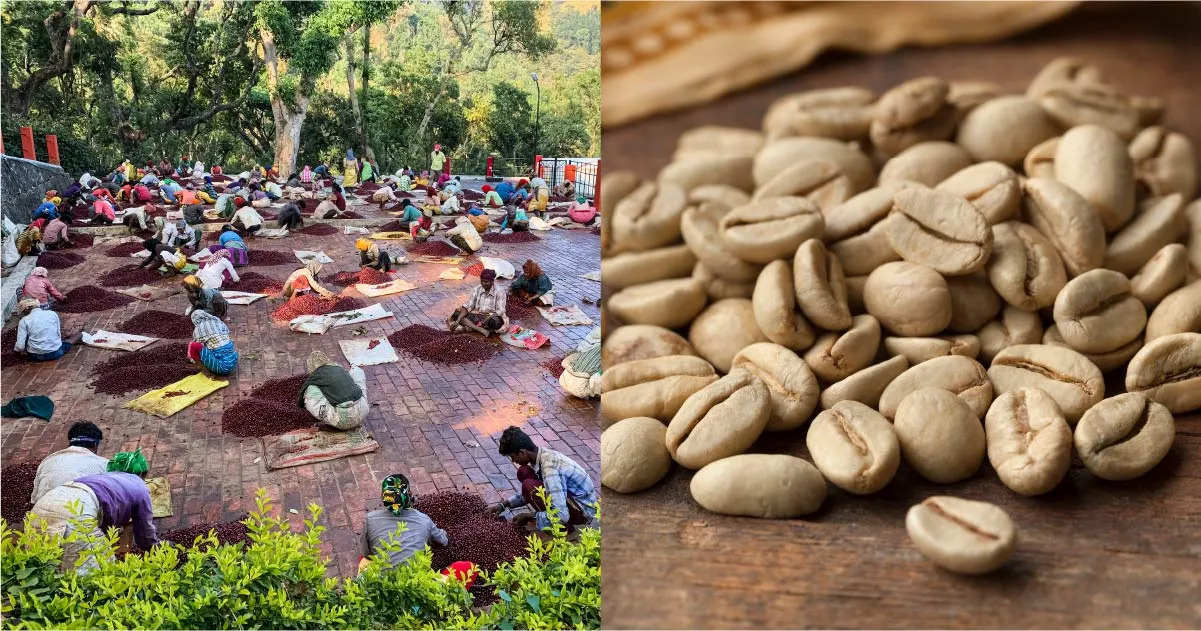
This unique blend is now created in India from June through September, where selected beans are placed in well-ventilated warehouses and exposed to moisture and monsoon winds for 12 to 16 weeks. This process involves careful sorting, repeated spreading, and raking to produce significantly larger, gold pale-colored coffee beans.
The result is a heavy-bodied, savory blend with a chocolatey aroma and notes of spice appreciated worldwide.